

Lomonosovsky Prospekt Metro Station


1/ 6
Lomonosovsky Prospekt Metro Station is a station on the Solntsevskaya Line, opened in 2017. The architectural design was developed by a team from Metrogiprotrans under the direction of Leonid Borzenkov. The station is part of a series of projects on the Minskaya–Ramenki section, united by a common architectural system but distinguished by their own color schemes and thematic design.
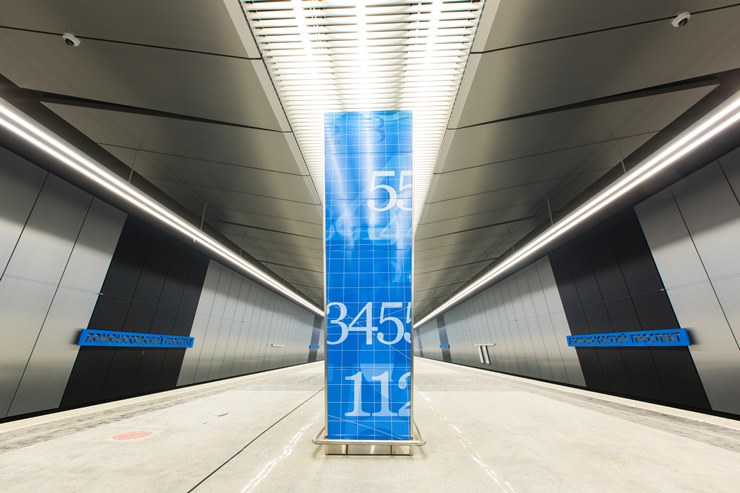
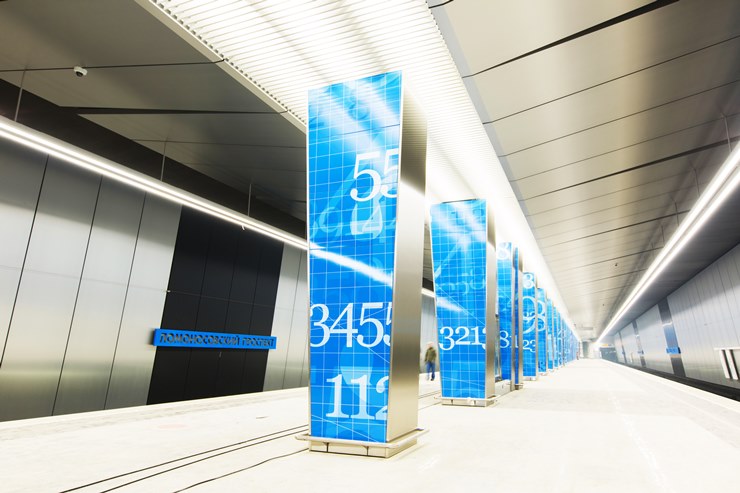
The main visual concept of Lomonosovsky Prospekt is the theme of science. Against a blue background, intersecting rows of numerals appear — fragments of the Fibonacci sequence, which reference exact sciences, Moscow State University, and Mikhail Lomonosov's scientific activities.
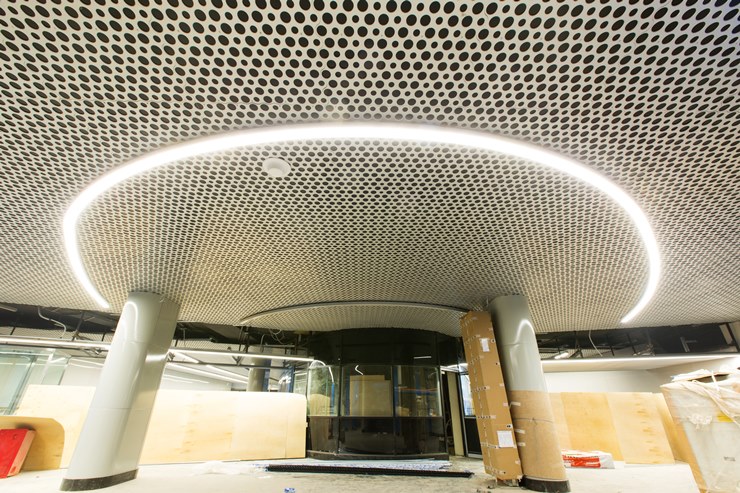
One of the key interior materials is aluminium. Large-format three-layer aluminium honeycomb panels are used on the platform and in the vestibules, while perforated panels and metal slat systems are incorporated into the ceiling structures. Thanks to its low weight and large format, the metal allows for the creation of continuous, even surfaces with minimal visual breaks.
Aluminium forms a calm neutral base on which saturated blue color and graphics work with particular expressiveness. Built-in lighting emphasizes the metal surfaces, while perforation and various types of panels add depth to the ceiling and walls without overloading the space.
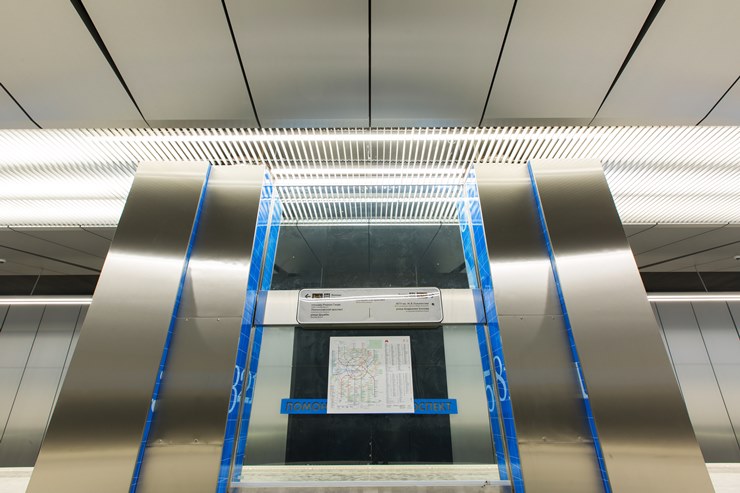
Metal is used here both as an architectural surface and as a carrier for imagery. In the vestibules, graphics are applied directly to large aluminium panels, so the finishing, color, and informational-artistic layer are perceived as a unified system.
As a result, Lomonosovsky Prospekt acquires a distinctive identity, built on the combination of aluminium, light, and graphics. Restrained metal architecture serves as a backdrop for the theme of science, while blue color and numerical compositions give the station its own distinctive character.
Project type
Transport infrastructure
Material
S.Comb — honeycomb panel, S.Con — pre-painted aluminium
Property location
Moscow

Metrohiprotrans
Metrohiprotrans, one of Russia's largest design and survey organizations, was founded in 1933. The institute's architects created a unique and remarkable world of underground architecture. Metrohiprotrans developed projects for the construction of all Moscow Metro lines currently in operation, spanning 300 km with 171 stations, technical and economic justifications for the construction of the first metro lines operating in Russia and most CIS countries, as well as projects for the construction of many railway, road, and hydraulic engineering tunnels, urban underground transport intersections, industrial and public buildings and structures.
Other projects


Order a sample
