

Brass sheets S.Brass





What is sheet brass
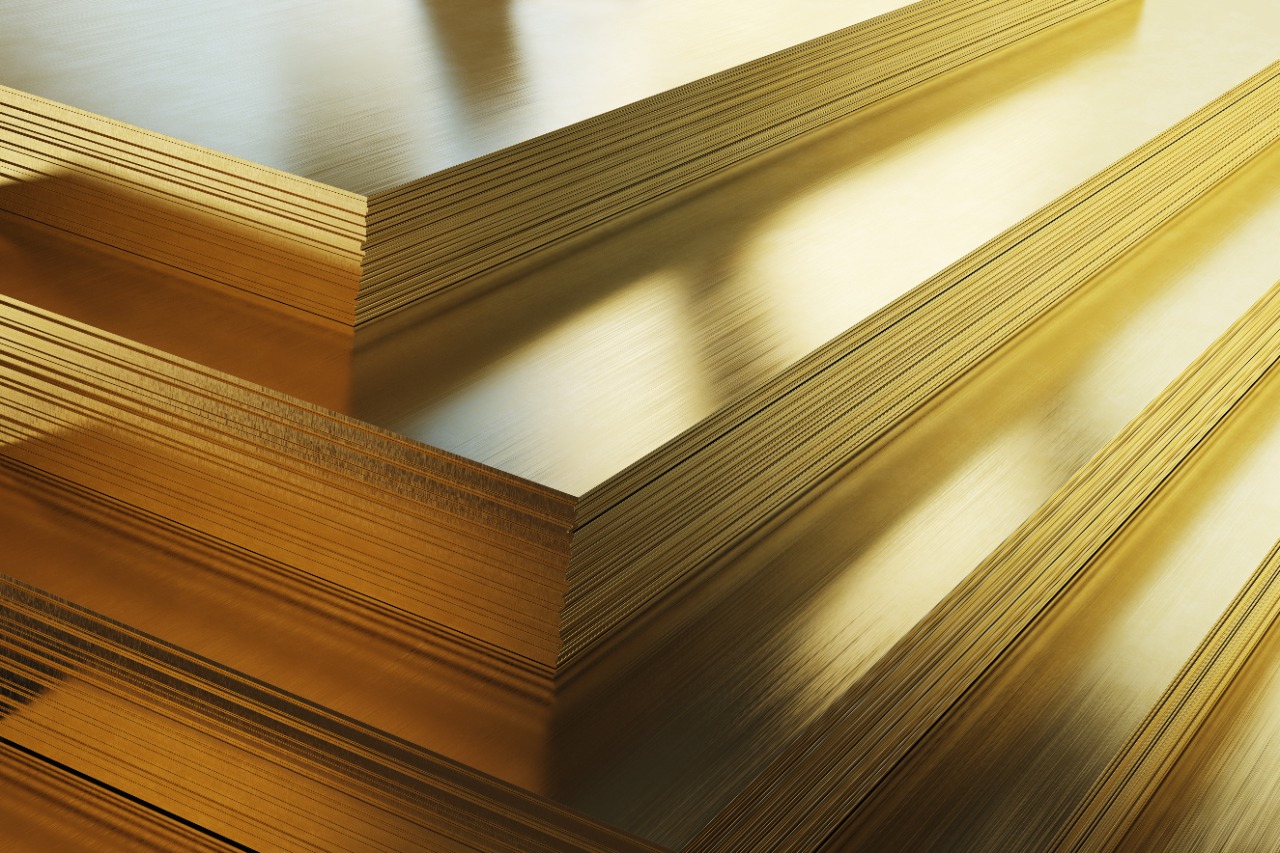
Sheet brass is a flat rolled product made from a brass alloy, produced by hot or cold rolling. Depending on the manufacturing technology and chemical composition, sheets can have different thickness, sizes and mechanical properties.
Composition and brass grades
The main components of brass are copper (Cu) and zinc (Zn). Depending on the percentage ratio, the properties of the alloy change. The most common grade is L63, containing approximately 63% copper and 37% zinc. This alloy is distinguished by high plasticity, good strength and a bright golden colour.
Other popular grades:
-
L68 — increased copper content, more ductile.
-
LS59-1 — contains lead, which improves machinability.
Material condition
By condition, brass sheets are divided into:
-
Soft (M) — bend easily, suitable for stamping and deep drawing.
-
Half-hard (P) — optimal balance of plasticity and strength.
-
Hard (T) — increased strength, reduced plasticity.
Sheet thickness ranges from 0.4 mm to 80 mm depending on grade and production method.
Production to standards
Quality sheet brass is manufactured in accordance with GOST 2208-2007, which regulates technical requirements for foil, strips, bands, sheets and plates of brass for general purposes.
Advantages of brass sheets
Corrosion resistance
Brass does not rust and resists the effects of moisture, atmospheric precipitation and many chemically active substances. This makes it an ideal material for exterior finishing and use in harsh conditions.
Plasticity and machinability
Brass sheets easily undergo various types of mechanical processing: bending, cutting, stamping, milling, polishing, soldering and welding. The material bends without cracks or tears, allowing for the creation of complex-shaped products.
High strength and wear resistance
Brass is resistant to mechanical loads, abrasion and deformation. Products made from it retain their properties for many years even with intensive use.
Heat and electrical conductivity
The alloy has good thermal and electrical conductivity, thanks to which it is widely used in the electrical industry and instrumentation.
Aesthetic appeal
The golden shade of brass resembles precious metals, making it a popular choice for decorative and interior solutions. If desired, the surface can be polished to a mirror shine or, conversely, patinated for an aged effect.
Where sheet brass is used
Architecture and construction
-
Building facades. Ventilated facades made of brass give buildings a prestigious appearance and protect against corrosion.
-
Roofing elements. Cornices, flashing, gutters, canopies.
-
Cladding of columns and entrance groups.
Interior design
-
Wall panels. Brass sheets are used for finishing accent walls in restaurants, hotels and private homes.
-
Bar counters, countertops, kitchen backsplashes.
-
Staircase railings, handrails, decorative inserts.
Mechanical engineering and instrumentation
-
Manufacturing of mechanism parts: shafts, axles, pins, guides.
-
Production of housings for measuring devices and instruments.
-
Automotive engineering: body parts, interior elements.
Decorative arts and advertising
-
Information plaques, signs, memorial boards.
-
Manufacturing of jewellery and accessories.
-
Production of interior items: lamps, mirror frames, furniture elements.
How to choose a brass sheet
Sheet thickness
| Thickness | Application |
|---|---|
| 0.4–0.8 mm | Decorative elements, jewellery, thin stamping |
| 1.0–3.0 mm | Facade panels, signs, instrument parts |
| 4.0–10 mm | Mechanical parts, reinforced structures |
| 12–80 mm | Plates for heavy mechanical engineering |
Sheet size
Standard sizes of sheet brass: 600×1500 mm, 1000×2000 mm, 1000×3000 mm and others. Non-standard sizes can be manufactured to order.
Alloy grade
| Grade | Copper, % | Zinc, % | Features |
|---|---|---|---|
| L63 | ~63 | ~37 | Universal, high plasticity |
| L68 | ~68 | ~32 | Increased plasticity |
| LS59-1 | ~59 | ~40 + lead | Easily machined |
Condition of supply
-
Soft (M) — for deep drawing and stamping.
-
Half-hard (P) — for most construction and decorative tasks.
-
Hard (T) — for parts working under load.
Type of surface treatment
-
Hot-rolled — thicker sheets (from 3 mm), increased strength.
-
Cold-rolled — thin sheets (from 0.4 mm), high dimensional accuracy and surface quality.
Why buy sheet brass from a manufacturer
If you decide to buy sheet brass, working directly with a manufacturer provides several important advantages.
Factory prices
Without distributor and middleman markups. Factory prices for brass sheet per m² in Moscow are 15–25% below market prices.
Quality control
The manufacturer is responsible for compliance with GOST 2208-2007, chemical composition and mechanical properties. You receive certified material with a guarantee.
Any size for your project
The manufacturer can make sheets of non-standard sizes exactly according to your drawings. This minimises waste.
Delivery throughout Russia
We ship products to any region of the RF through verified transport companies. Delivery to a Moscow terminal is often free.
Technical support
We will advise you on the choice of grade, thickness and material condition for your task.
Factory prices for brass sheet per m² in Moscow
Approximate factory prices for brass sheet per m² in Moscow (order from 100 kg, L63 grade):
| Thickness | Price per kg (approximately) | Price per m² (approximately) |
|---|---|---|
| 0.5 mm | from 900 ₽ | from 700 ₽ |
| 1.0 mm | from 850 ₽ | from 1,300 ₽ |
| 2.0 mm | from 850 ₽ | from 2,500 ₽ |
| 3.0 mm | from 850 ₽ | from 3,800 ₽ |
| 5.0 mm | from 950 ₽ | from 8,000 ₽ |
Prices are given approximately. Exact cost is calculated based on current metal prices, order volume and type of processing.
For large projects (from 1 tonne), discounts up to 10–15% are possible. Grades L68 and LS59-1 may differ slightly in price.
Frequently asked questions
1. How does brass differ from bronze?
Brass is an alloy of copper with zinc. Bronze is an alloy of copper with tin (rarely with aluminium, silicon, beryllium). Brass has a golden colour, is more ductile, easier to machine and stamp. Bronze is stronger and has a reddish-brown shade.
2. How to care for brass products?
-
To maintain shine — polish with a soft cloth using special paste.
-
To protect from darkening — coat with clear lacquer.
-
For an aged effect — patination (treatment with chemical compounds).
-
To clean the oxide film — use citric acid or vinegar solutions.
3. Can brass sheets be used for exterior finishing?
Yes. Brass is resistant to corrosion and atmospheric effects. Over time it may darken and acquire a patina, giving the facade a noble 'aged' appearance. To preserve the original colour, lacquering is recommended.
4. How to calculate the weight of a brass sheet?
Sheet weight can be calculated using the formula: length (m) × width (m) × thickness (mm) × alloy density (g/cm³). The density of L63 and L68 brass grades is approximately 8.4–8.5 g/cm³.
5. Which brass grade to choose for manufacturing decorative elements?
For decorative purposes, L63 (universal, polishes well) or L68 (more ductile for complex shapes) are best suited. For elements requiring frequent machining (drilling, thread cutting), the LS59-1 grade is convenient.
Brass — a durable and aesthetic material
Sheet brass is a noble, durable and aesthetic material that finds application in architecture, design, mechanical engineering and decorative arts. Correct choice of grade, thickness and condition of supply ensures that the product will serve for many years and please the eye with its golden sheen.
If you want to buy sheet brass from a manufacturer, contact Cladding Solutions. You will receive quality certified material, any thickness and sizes for your project, honest factory prices for brass sheet per m² in Moscow and delivery throughout the RF. Make your project stylish, reliable and durable